©2023 Snapping the Globe, L.L.C. All rights reserved.
While visiting Venice is an amazing experience, after having been there many times, one gets the itch to see other cities in the region. Having already taken the train to Padua a few years prior, I was planning on seeing some other nearby cities. On this particular day, however, realizing that we had arrived a little earlier than normal, I decided to venture out a little further…to Verona.
Verona is one of the main tourist destinations in northern Italy, situated on the Adige River and known as the setting for two of William Shakespeare’s plays, Romeo and Juliet and The Two Gentlemen of Verona. Because of its artistic heritage and opera season staged in its Roman amphitheater, it attracts millions of visitors each year.
Ruled by the della Scala family during the 13th and 14th century, the city was extremely prosperous during their reign and this wealth can be spied throughout its boundaries today; in its monuments, walls and architecture and more. While I was aware that many tourists head straight to Juliet’s House and Museum, one of the most famous places in the city, I decided to do this as well, but also to see the other aspects that make this UNESCO World Heritage Site so special.
After the hour and ten minute train ride, I quickly ducked into a station shop to purchase a face mask for the return trip or for any other attraction which might require it. During my train ride, I had realized that KN95 face masks were still required on public transportation when conductors removed five British travelers at the stop prior to Verona’s Porta Nuova station. While I had a regular surgical mask, I realized that it was not enough and was thankful that I went unnoticed.

Thankful that crisis had been averted, I set out to walk to the city center, first stopping at the Porta Nuova (https://snappingtheglobe.com/?p=30718), the city’s old gate. Stopping for a few photos, I then continued on Corso Porta Nuova past Giardini Pradaval and its sculptures and statues, the Lapidary Museum Maffeiano and I Portoni della Bra the historic gate that once divided the city from the countryside and connects the Porta Nuova railway station to Piazza Bra. While I felt welcomed by the city gate Porta Nuova, it was when I walked through the arches of I Portoni della Bra that I felt as though I was truly entering the city and readied myself for the city’s beauty.


Having planned to see the amphitheater, I decided to take a detour and walk toward the river and the Castelvecchio Museum, since its opening hours were fewer. Making my way across its intimidating drawbridge into the courtyard, I then headed inside to make my way through its major Italian art collections distributed over twenty-nine rooms. Sculpture, paintings, ancient weapons, ceramics, goldsmiths, miniatures and ancient city bells were artfully displayed throughout the castle which dates back to the mid 1300s. While it was built as a residence for the della Scala family, it was mainly used for the military defense of the city and that is evident by its towering walls and battlements.


While I enjoyed my walk through the castle’s interior, what I really wanted to do was investigate the courtyards, the battlements and the clock tower. Climbing up the stairway, I made my way first to the rear of the castle and was rewarded with stunning views of the river and the Scaligero Bridge. It was a beautiful day and being out on the walls was the perfect place to be! Some of the passageways were a bit narrow but easy to navigate and to reach the seven towers. From the front of the castle, the views of the city, the large courtyard, the clock tower and the small courtyard beneath the tower were so stunning that I could have stayed up there all day. Finally, I passed through the adjacent walkway to the bridge and took a quick stroll across so that I could say “I did”.


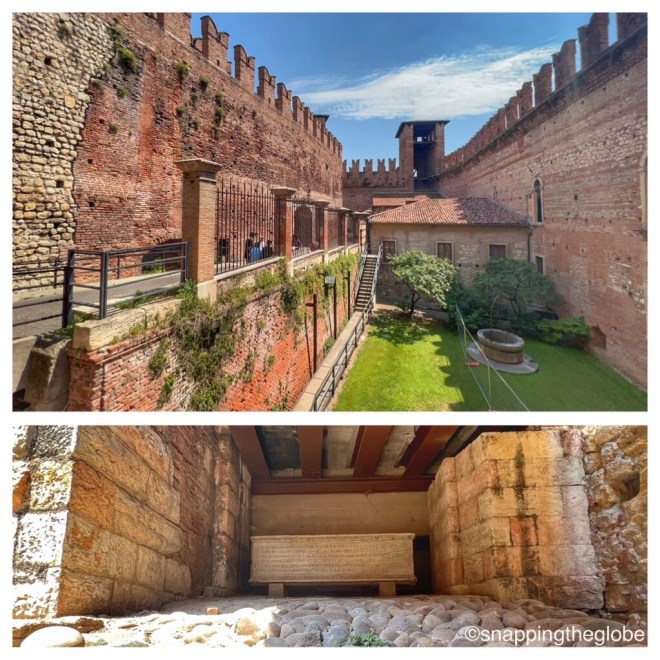


If I was going to see everything, however, it was time to move on and I decided to continue my path along the Corso Cavour, which follows the river. A short stroll later, I passed the Arco dei Gavi, a massive, ancient white-marble arch which was was used as a gate in the walls during the Middle Ages. During the Napoleonic rule, French engineers demolished it and its ruins were moved to a square and then to the arena. In 1932, the arch was reconstructed, under Mussolini’s rule, in its current spot next to the Castelvecchio, very near its original location.

A little further down the road, I happened upon the Basilica di San Lorenzo. As I always make time for a church, I spent a few moments walking through this 12th structure. Built in the Romanesque style on the remains of a 5th or 6th century paleo-Christian building, using some of the original materials, it was interesting to see the two different types of building materials stemming from the different phases of construction…alternating brick and stone which gives the interior a striking pattern of strips in the columns and the walls and apse. Listening in to a tour guide’s spiel, I also learned that a unique feature is the presence of the women’s galleries, still intact and open onto three sides. Though my stop was a quick one, I was glad to see this beautiful church.


Near the Ponte della Vittoria, I decided to move into the city center as there was more to see in that domain. A few minutes later, I passed under the impressive Porta Borsari, the arched limestone gate, which dates back to the 1st century and served as the main entrance to the city.

There were many more churches, including the Church of St. Eufemia; some open, some closed for the afternoon, and as I spied many balconies, I thought of Juliet’s House, which I had planned to visit…whenever I got there! But of course, there was so much to see along the way!

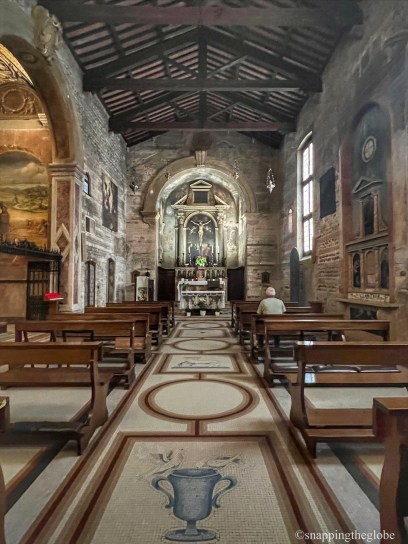
Glancing at my watch, I decided to snatch a few moments at the Church of San Giovanni in Foro. A minor church, it was built on what was the main Roman road. Badly damaged by fire in 1172, while much of Verona was destroyed, its restoration in the early 1900s led to the discovery that Roman walls had been incorporated into the external walls of the church. It was small and dimly lit, but its beautiful mosaics, stone walls and ancient paintings made me glad that I had stumbled upon this gem.

Continuing on, I finally made my way to the beautiful Piazza delle Erbe, which was once the center of the city’s political and economic life. There were many market stalls hawking souvenirs and food, but there were lots of statues, fountains and other landmarks to see. More importantly, the square is surrounded by many buildings and monuments that have marked the history of Verona…City Hall, Lamberti Tower, the Houses of Mazzanti, Maffei Palace, the Gardello Tower and the Casa dei Mercanti (Merchant’s House). What I loved most, however, was the ancient fountain (circa 1368) with its roman statue, Madonna Verona, built by Bonino da Campione, which stands proudly in the center of the square and welcomes visitors to investigate its history.


My goodness…what wasn’t there to see? I love everything about Rome and its “in your face architecture”, but the simplicity of Verona with the minor details that begged you to slow down and savor it was unlike anything I had ever experienced in Italy. Everywhere I laid my eyes, there was stunning construction, architectural details on every building, including balconies upon which other Italian ladies, like the fictional Juliet, may have stood, conversing down to their young paramours.


Finding my way to the Scaliger Tombs, I decided that I needed to enter the premises so that I could see these stunning tombs at close range. After paying my entrance fee, I was given a handout to guide me through the small courtyard. Each of the elaborate tombs were unique and some just outright ostentatious. While passerby could get a glimpse through the iron bars of all of the tombs, I thought it much better to see their beauty unobstructed.

These five funerary monuments celebrate the Scaliger family who ruled in Verona from the 13th to the late 14th century. Located in a wrought-iron fenced enclosure of the church of Santa Maria Antica, these Gothic tombs were constructed for the wealthy members of the noble Scaliger dynasty who ruled as the Lords of Verona; Cangrande I, Mastino II, Cansignorio, Alberto II and Giovanni.


The church was open and I was given a covering for my shoulders as I entered. The modest sanctuary was dimly lit and quiet and it didn’t appear that photographs were appreciated by the woman keeping a sharp eye on the visitors. While I was able to capture a couple undetected, as I was inspecting the 14th century frescoes in the central nave, I took a moment to nod my head in prayer before leaving.

Finally, next on the list was the famed Juliet’s House, a short walk away. As expected, after walking through the short corridor to the courtyard, I found it extremely crowded with other visitors. Everyone was jockeying for position and waiting for their chance to pose with the bronze statue of Juliet. Noting the balcony above, and those also posing there for photographs, I figured out which door to enter to pay my admission.


Inside, there were statues paying homage to Shakespeare, another bronze statue of Juliet, period furniture and the bed and Renaissance costumes from Franco Zeffirelli’s 1968 film version of Romeo and Juliet. The wooden floors and artfully decorated ceilings were extremely cozy, although very roomy, depicting the wealth of the Capello family (from which the name Capulet was derived). Eventually, I was able to step out onto the balcony and also pose for a photo, but I was interested to find that even though the house dates back to 13th century, the balcony was only added during the 20th century.


On my way out, I noticed the red mailbox, which collects the letters “to Juliet” from visitors. Remembering the 2010 movie Letters to Juliet, I smiled at the messages visible in the small window in the center, glancing around, wondering where the women who volunteer to answer them were.
Just up the road, I happened upon Porta Leoni, the ancient gate that was built during the Roman Republic and features a double façade and two towers. Adjacent, below the street level are amazing Roman excavations.

The afternoon was dwindling away and although I had seen so much during my afternoon visit to Verona, I still wanted to see the amphitheater. Deciding to walk along the river in order to make navigation back to Corso Porta Nuova a little easier, I was stopped in my tracks by an imposing church on the corner.
Chiesa di San Fermo Maggiore.


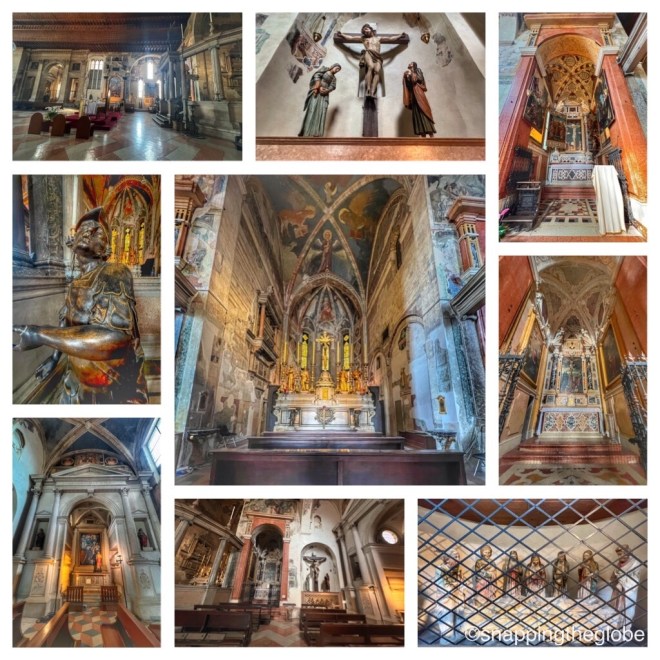
Oh, I was here and I couldn’t resist, so I went in, hoping I had enough time for everything else on my list…namely the amphitheater. The church was still open and I paid my admission, following the handout offered to me, which guided me to both the Upper and Lower churches.


Starting with the Lower church, I traversed the ancient staircase to reach the first and oldest cloister of the complex. Here, I marveled at the decorated ribbed vaults and frescoed columns which divided the space. Of particular note was the early 14th century fresco depicting the Virgin seated on a throne with baby Jesus and a 12th century fresco of the Baptism of Jesus. There is a tombstone of jurist Antonio Pelacani, who died in 1327, showing him teaching his students and another of scholar Master Omobono, built in 1330. In the presbytery, there is a wooden crucifix from the 14th century and in the right transept, the stone upon which saints Fermo and Rustico were beheaded.


Back upstairs in the Upper church, I found it to be a massive and towering space. Again, crumbling frescoes decorated the walls and a large wooden door was topped with a fresco of the Crucifixion of Christ. The single nave church contained five apses and of particular interest was the Della Torre altar, from the 18th century, Our Lady’s Chapel (1613), which contains a some significant paintings and the presbytery with its marble altar, created by Schiavi, on which the relics of Saints Fermo and Rustico are kept.


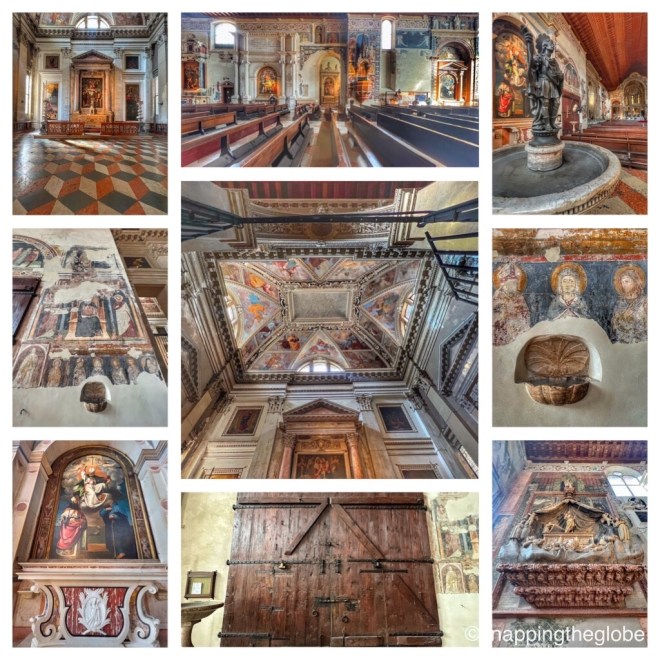

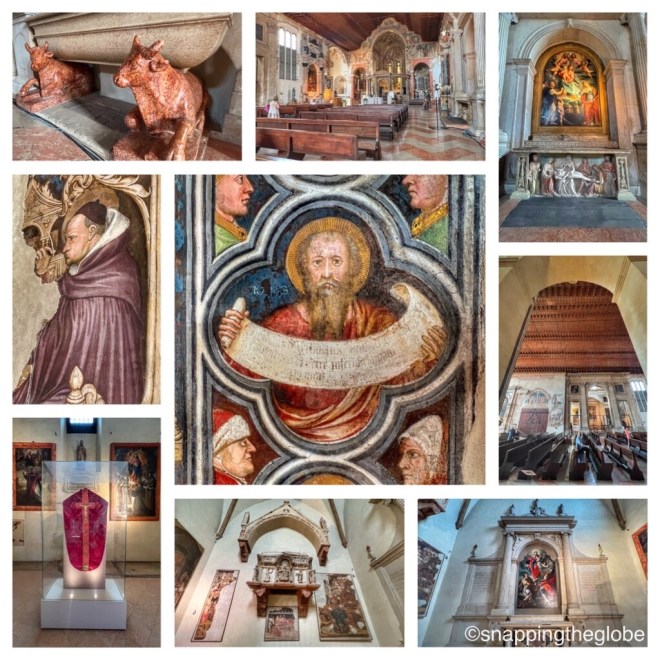

There were many tourists here and there was so much to see in the Upper Church that I spent much more time here than I had anticipated. As I finally exited San Fermo, I regained my routing along the river to head back toward the center of the city where the amphitheater was located. Taking much longer than I had anticipated, along with the heat of the afternoon slowing me down, I realized that I had maybe need to check the train schedule. I was still a ways from the train station and just over an hour away from Venice. As I realized that if I didn’t make the next train, I would be arriving into the Mestre station pretty late and I still needed to keep in mind dinner and the 20 minute walk back to my hotel. Upper ChurchThere were many tourists here and there was so much to see in the Upper Church that I spent much more time here than I had anticipated. As I finally exited San Fermo, I regained my routing along the river to head back toward the center of the city where the amphitheater was located. Taking much longer than I had anticipated, along with the heat of the afternoon slowing me down, I realized that I had maybe need to check the train schedule. I was still a ways from the train station and just over an hour away from Venice. As I realized that if I didn’t make the next train, I would be arriving into the Mestre station pretty late and I still needed to keep in mind dinner and the 20 minute walk back to my hotel.
Sadly, I had saved the amphitheater for last and it was not meant to be.
This time…
With so much to see in Verona, I was impressed with what I had undertaken and experience in a single afternoon. As there is much more enjoy in Verona, I realized that I would definitely return in the near future.
Pulling my KN95 mask from my bag…it was time to make that train.
.For more pictures, check out Facebook, Snapping the Globe and Instagram, @snappingtheglobe.
Castelvecchio Museum
- https://museodicastelvecchio.comune.verona.it/nqcontent.cfm?a_id=42545
- Address: Corso Castelvecchio, 2, Verona, Italy
- Hours: Tuesday to Sunday, 1000 to1800. Last entrance at 1715. Closed Mondays, December 24, January 1.
- Admission: Adults, €6.00 (+ €.60 online presale), Children (ages 8-14 years), €1.00 (+€.10 online presale). Free admission for residents of 65 years in the Municipality of Verona, persons with disabilities and their companion, children up to 7 years, holders of the VeronaCard.
Arco dei Gavi
- https://www.verona.in/verona/what-to-see/details/arco-dei-gavi
- Address: Corso Cavour, 2, 37121 Verona VR, Italy
- Hours: 24 hours, daily
- Admission: free
Basilica di San Lorenzo
- https://verona.com/it/verona/chiesa-di-san-lorenzo/
- Address: Corso Cavour, 28, 37121 Verona VR, Italy
- Hours: 0900-1200 and 1500-1700
- Admission: free
Porta Borsari
- Address: Corso Porta Borsari, 57A, 37121 Verona VR, Italy
- Hours: 24 hours, daily
- Admission: free
Chiesa di San Giovanni in Foro
- Address: Corso Porta Borsari, 20, 37121 Verona VR, Italy
- Hours: hours unknown
- Admission: free
Piazza delle Erbe
- https://verona.com/en/verona/piazza-delle-erbe/
- Address: Piazza delle Erbe, 37121, Verona VR, Italy
- Hours: 0730-2030, daily
- Admission: free
Scaliger Tombs
- Address: Via San M. Antica 1, Verona VR, Italy
- Hours: unknown
- Admission: €3 (unverified)
Juliet’s House
- https://verona.com/en/verona/casa-di-giulietta/
- Address: Via Cappello, 23, 37121, Verona VR, Italy
- Hours: 0900-1900, daily
- Admission: Adults, €6
Porta Leoni
- Address: Via Leoni, 37100 Verona VR, Italy
- Hours: 24 hours daily
- Admission: free
Chiesa di San Fermo Maggiore
- https://www.chieseverona.it/it/le-chiese/la-chiesa-di-san-fermo
- Address: Corte S. Elena, Piazza Duomo 35, 37121, Verona VR, Italy
- Hours: Monday to Friday, 1100-1800, Saturday, 0930-1800, Sunday, 1300-1800
- Admission: Single entry €4. Entry to four churches, San Fermo, San Zeno, Cathedral Complex and Santa Anastasia, Basilica of San Zeno, the Cathedral Complex, the Basilica of Santa Anastasia, €8

 Happy birthday to me…


 Finally, a boat docked on the banks and we were given life vests and ushered down into the waiting vessel. Motoring along the calm, shallow waters, its banks lined with the local flora and fauna, I couldn’t keep the smile off of my face. This was truly an adventure!

 A beautiful waterfall.
 Swimming in the refreshing, cold, clear water with my son, I was elated that this was how I was able to start my day…enjoying nature at its most beautiful.


 The villagers, dressed in their handwoven and metal, embellished cloths danced together, sometimes only the women and sometimes joined by the men.
 The best was yet to come.
 After a visit to the kitchen hut, where we watched the women preparing food for the day, we were treated to a meal of locally caught, fresh, fried fish and fruit. We then browsed the vast selection of items crafted by the tribe members…baskets, fabrics, jewelry, plates and masks…while watching the younger members of the tribe play under the tables and outside in the puddles. Here, you can also have a non-permanent tattoo applied to your skin and watch some of the finest basket makers in the world as they work to create intricate all sizes of baskets with intricate patterns from palm leaves and natural pigments.


 The rain was still coming down, though not as hard, and it was time to head down to the boat and back to our origination point. The beauty of the region was not lost on us, regardless of the weather, but the usual sights of sloth’s, monkeys, toucans and eagles would not be had on this day.


 The sun rose higher as we glided down river, finally pulling our boats onto the shore for our first rest and excursion. Arizona Hot Springs. Walking past boulders, gushing streams and high bluffs, we made our way inland through the slot canyon, noticing the temperature around us rising. Stepping into the water, it was noticeably warmer. Further upstream, the temperatures rose even higher. Climbing a twenty foot ladder to an overhead cliff, the water temperature was extremely hot, pouring forth from a geothermal spring. Taking a seat, we soaked for a few minutes, our muscles enjoying the torridity.


 Even though I had done a short rafting trip (5 km) in Thailand in the Phang Nga province a few years ago, I felt a different dynamic here and was a bit nervous, especially when we were instructed on what to do within the raft…besides paddle. There was so much to remember, depending on what the conditions were in the river. If there were many rocks…“Get Down”…and we had to slide down to the floor of the raft and hold our paddles upright. “Paddle Forward” and “Paddle Back” were the easiest. Then, the scariest of the instructions…What To Do If You Fall Out of the Raft! Surely that wasn’t going to happen?


 Before long, we were pulling up to the dilapidated dock at Unicorn Island. Venturing up the path to a pavilion at a local bee farm, we were shown some of the wooden bee hives and one of the wooden frames filled with bees and a honeycomb. Our tour guide invited each of us to hold the frame…which, of course, I did!
 We were then invited to have a seat and enjoy tea, some of the honey and some tasty treats. After teatime was complete and we were exiting the pavilion, we were shown a cage, home to a boa constrictor. Not a native species, it was explained that the villagers keep the snake as a pet and to impress the tourists. The large snake was removed from its pen so that we could have a closer look. Feeling the snake’s skin, I was impressed with how smooth and cool to the touch it was and when my tour guide offered the snake to me, I decided to live in the moment and let him drape it around my neck, praying that it would not decide to strangle me! An exciting experience, I was extremely glad that I had allowed him to do so…where do you ever get the chance to have a boa constrictor around your neck?


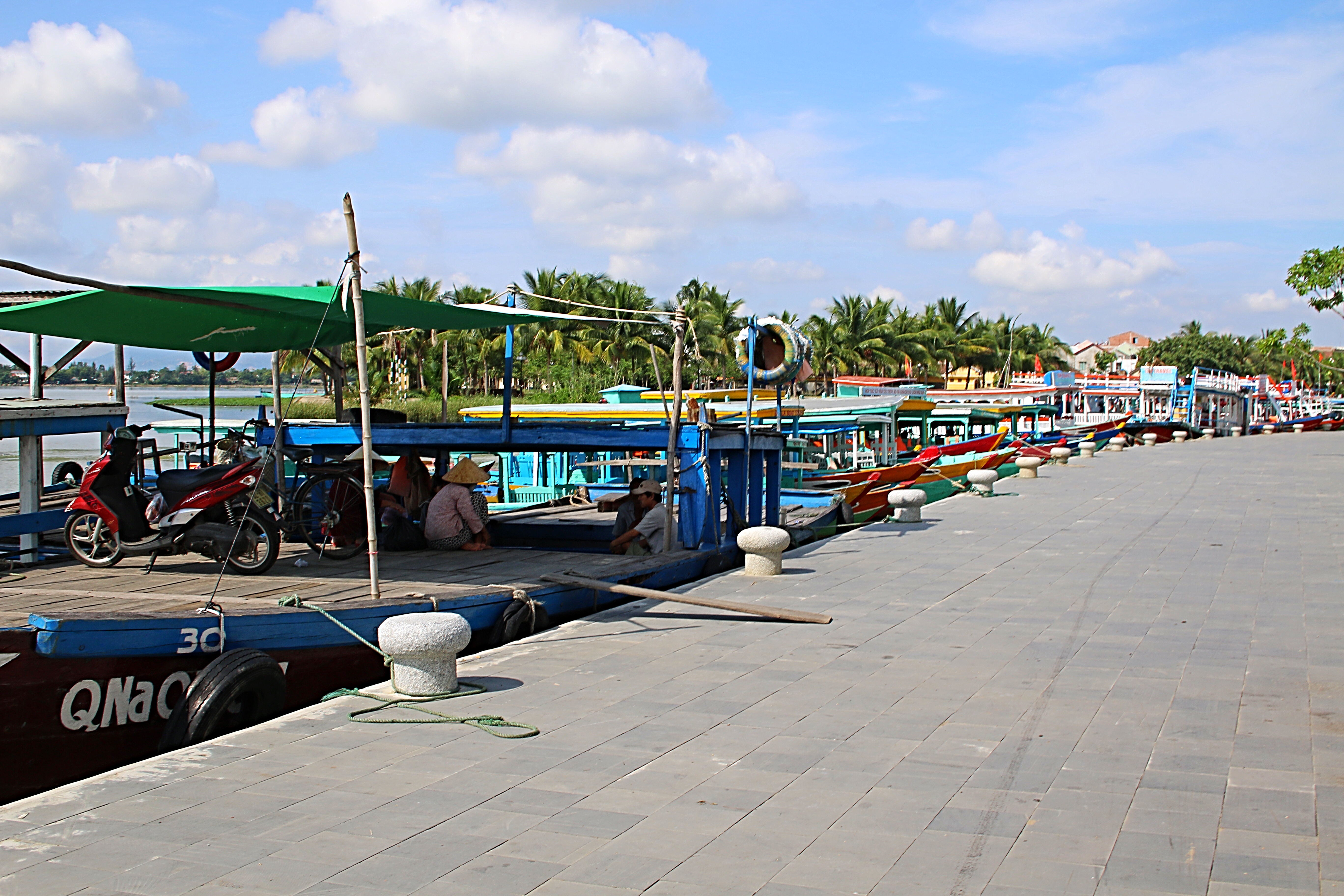
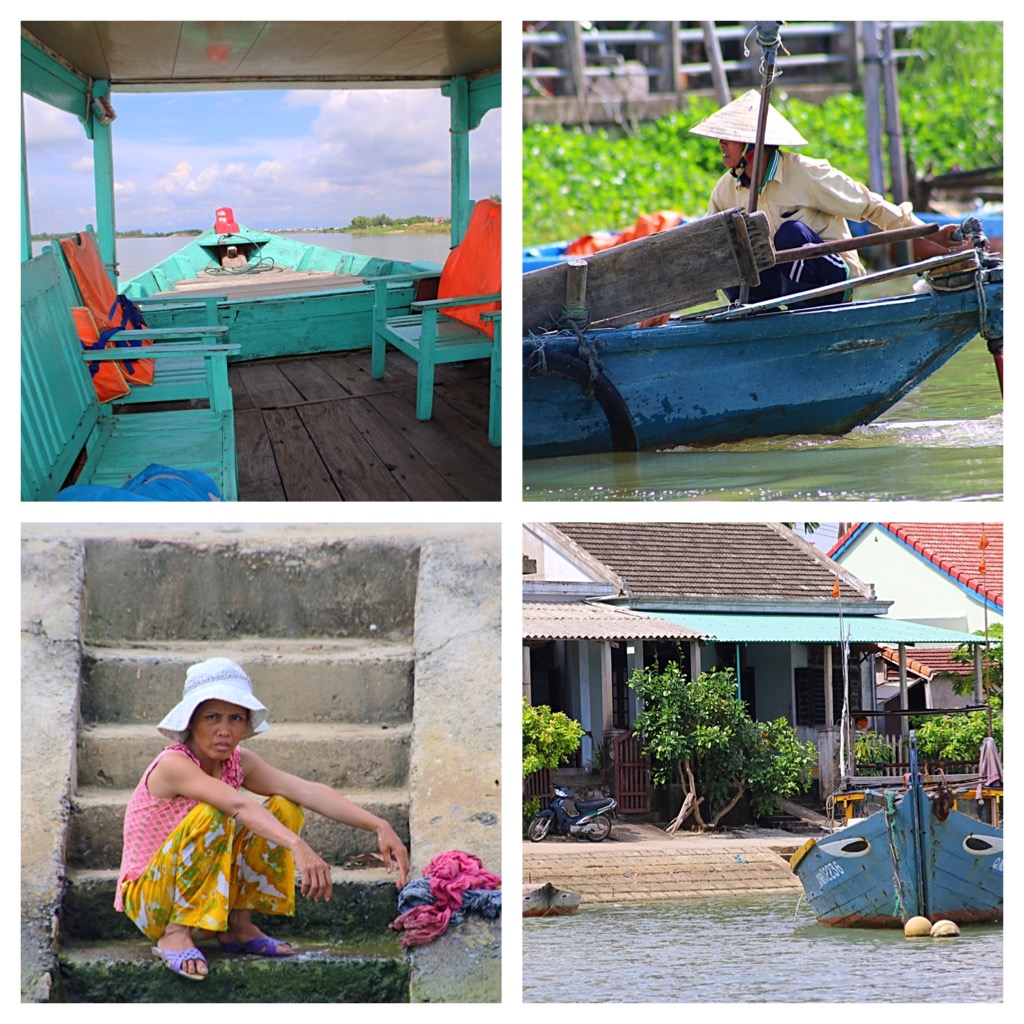
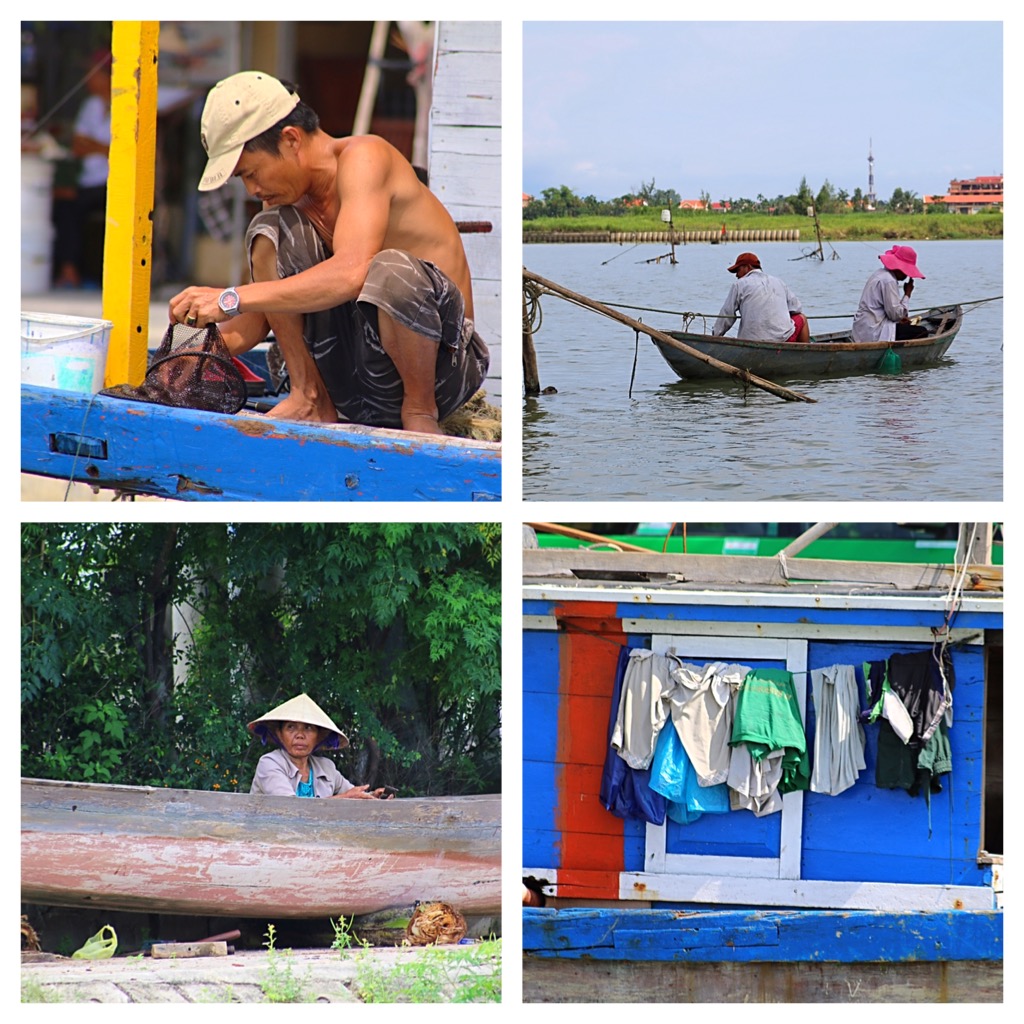
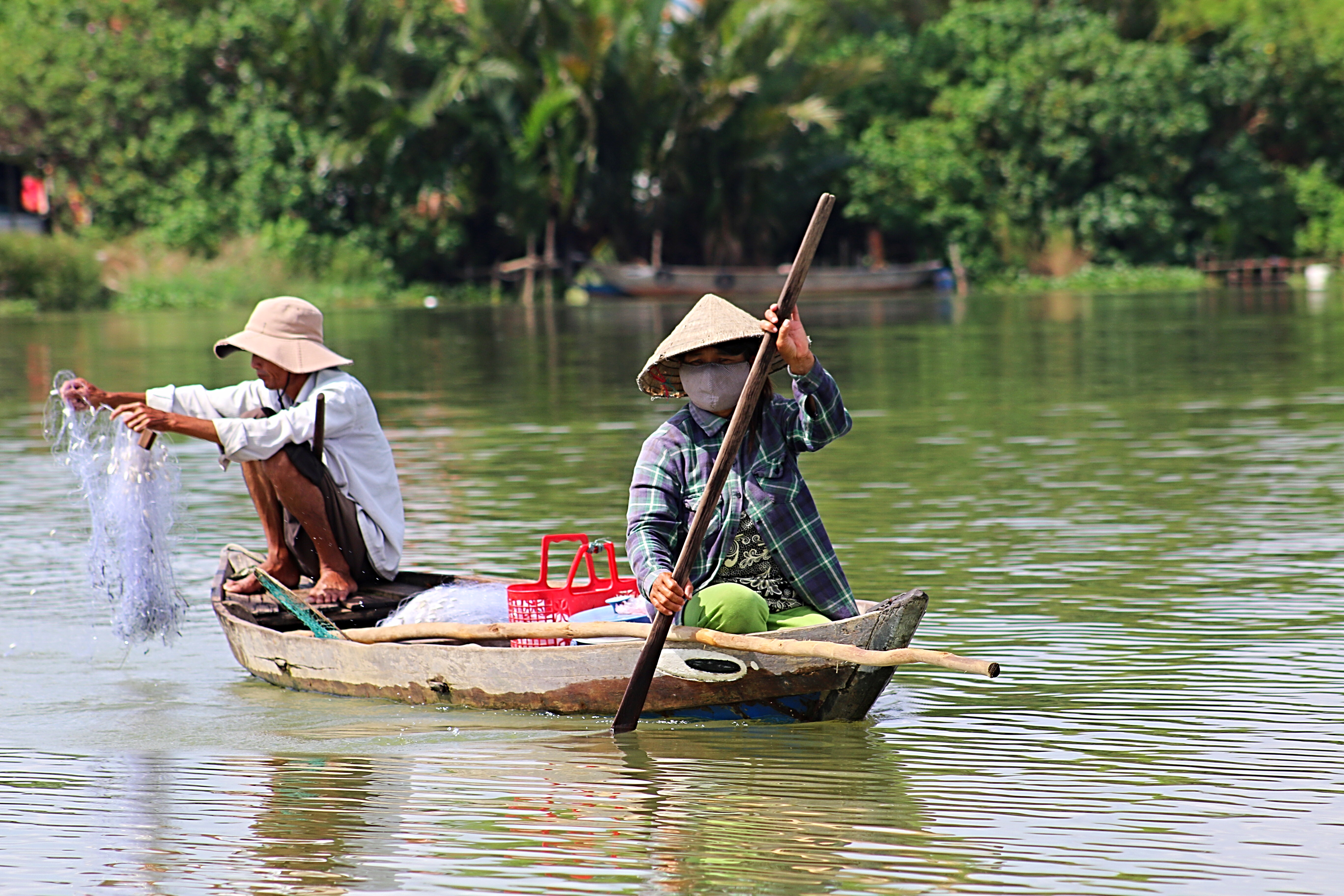
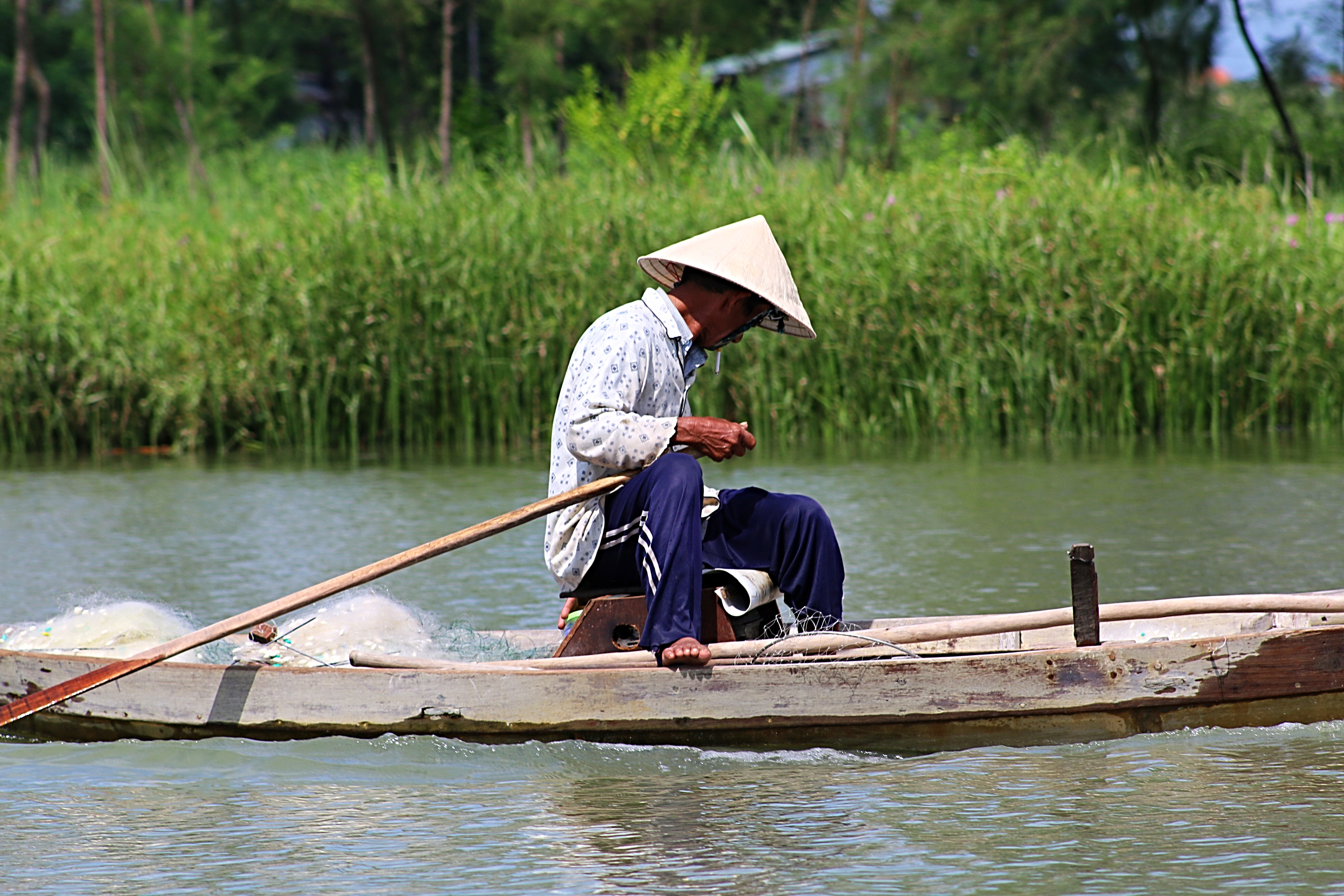
 Making our way down a palm-laden path, we found ourselves making our way down to another dock alongside a narrow canal on the Mekong Delta. Given conical hats to wear as we boarded sampans, we headed out into the shady waterways, sometimes making way for the many boats heading in the opposite direction down the same narrow canal. It was thrilling as we all jockeyed for space, but an amazing opportunity to get up-close and personal pictures of some of the villagers and their boats.


 After reluctantly surrendering our hats, we were ushered off of the sampan onto another dock onto our original boat. Motoring down a much larger waterway, we soon pulled up to another area on Unicorn Island. A few small drops of rain were starting to fall as we make our way to the coconut candy factory where keo dua, was made. One of the most popular candies in Vietnam, the chewy candy is consumed in Vietnam and also exported to nearby countries such as Cambodia and Thailand. We were able to witness all phases of production. Simple and tasty, the candy is made from coconut and sometimes mixed with other fruits like durian or roasted peanuts.

 Remembering that I purchased some of these candies last year while in Cambodia, I didn’t remember them fondly. The problem was that once I unwrapped the candy, there was a thin wrapping on the candy that I had a hard time getting completely off. Thinking that I wasn’t supposed to eat the thin wrapping, I decided that it was too complicated and I threw it out. Well, the one important thing that I learned at the candy factory was that the thin rice paper wrapping is to keep the outer paper from sticking to the candy…and it’s edible! Purchasing three packages, these were all eaten quickly once I was home, now knowing how to eat them!
 Our tour group and a few others were seated under a large pavilion and served elephant ear fish and many other fruits, vegetables and local dishes. The rain had returned and the air was thick and moist. After our lunch, we were invited to utilize the dozens of hammocks struck between the trees on the property or the bicycles available for our use. Deciding to walk around the property instead, I checked out the turtle ponds, the alligator pens and other caged animals.

 Finally, we were gathered and boarded on our original boat. Pulling through the palm covered and bamboo lined canal, we soon merged into the Mekong river and made our way back to the main terminal. Reboarding our tour bus, we were soon on our way back to Ho Chi Minh City.